
 EN
 HR
A crawler tractor is often the stronger candidate when soft, wet ground limits access or traction. A wheeled tractor can be a better fit when the ground is firm, road travel is frequent, and a compact orchard tractor has enough clearance to work between rows. Neither undercarriage guarantees a good result: machine weight, tire or track configuration, implements, soil condition and turning space all matter.
The useful question is not simply which machine has better traction. It is whether the complete tractor-and-implement combination can enter the field, do the job without unacceptable soil or crop damage, turn at the row end, and move to the next block at a practical cost.
Crawler vs. wheeled tractor: a practical comparison
| Decision factor | Crawler tractor | Wheeled tractor |
|---|---|---|
| Soft, wet ground | A long track contact area can help distribute load and maintain traction; mud depth and the layer beneath still set limits. | Performance depends heavily on tire size, inflation, ballast and drive configuration; deep, soft patches can cause rutting or loss of traction. |
| Orchard row fit | Compact models can fit confined spaces, but tracks and implements need clearance and turning can disturb the surface. | A narrow orchard model may suit established rows; check its complete width, height and turning circle with the implement fitted. |
| Headland turns | Differential steering may permit tight turns; sharp turns can scrub soil and vegetation. | Steered wheels generally need a turning arc; the implement can swing beyond the tractor. |
| Field-to-field travel | Check transport speed, track wear and local road requirements; a trailer may be appropriate. | Often more convenient for road movement, subject to model, tire setup and local rules. |
| Upkeep | Inspect tracks, rollers, tension and accumulated mud; compare undercarriage parts and service access. | Inspect tires, pressure and drivetrain; compare tire wear and service costs for the actual duty cycle. |
Wet fields: compare flotation and traction together
Tracks spread a tractor's weight over a contact area that is often larger than a comparable tire footprint. That can reduce average surface pressure and help a machine stay mobile on soft ground. Actual soil response depends on total load, how weight is distributed, moisture, surface strength and what lies below it. Wide, correctly inflated tires can also improve flotation, so compare the machines as configured for the job.
Traction is a separate check. A tractor may remain on the surface but still slip when pulling a demanding implement. Ask for an assessment with the intended implement attached, at the expected working depth and field moisture. Examine wheel or track slip, rut depth, ground clearance and whether mud builds up around the undercarriage. Do not treat lower nominal ground pressure as permission to work in any wet field: soil structure can still be damaged, especially by repeated passes or a heavy implement.
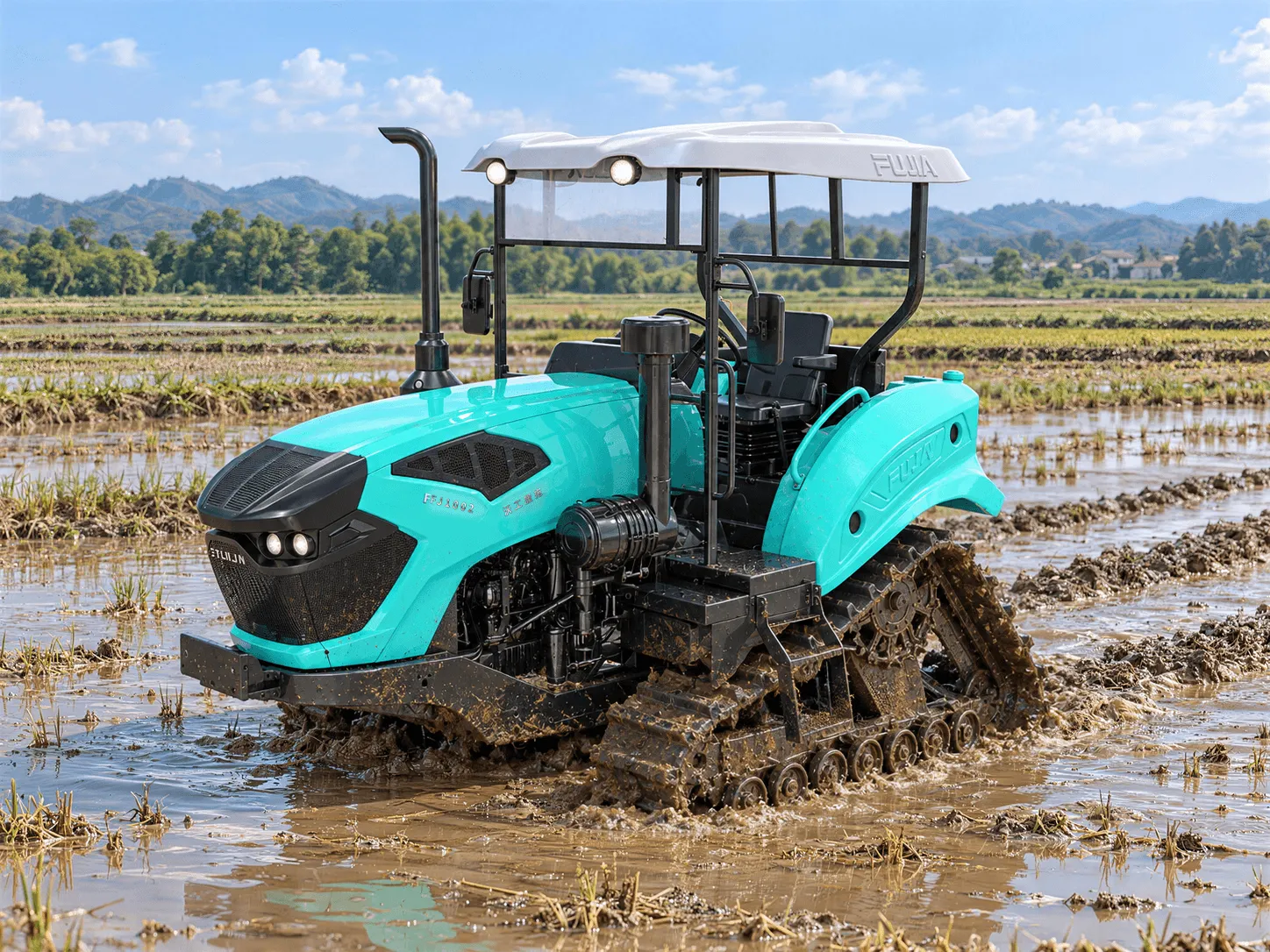
For paddy work, the FUJIA FJG1002 is specified with 450 mm tracks, a 1,440 mm track contact length and 560 mm minimum ground clearance. Its listed overall width is 1,910 mm. These dimensions help define a candidate, but they do not establish a maximum mud depth or guarantee operation in a particular field.
Orchards: measure the complete working envelope
In an orchard, a smaller footprint is useful only if the tractor, protective structure and implement fit between the trees throughout the pass. Measure the narrowest clear gap between trunks and branches, the lowest canopy, gate width and the available space at both row ends. Include mirrors, exhaust, sprayer arms, mower guards and any side-mounted equipment in the envelope.
Compare the width of the candidate machine and implement against that measured space, allowing a practical margin for steering and uneven ground. A tractor narrow enough to enter a row may still be too tall under the canopy or unable to turn into the next row without reversing. Check the operator's visibility and the turning path with the actual implement; a pivot turn is not automatically suitable close to roots, irrigation lines or fruit trees.
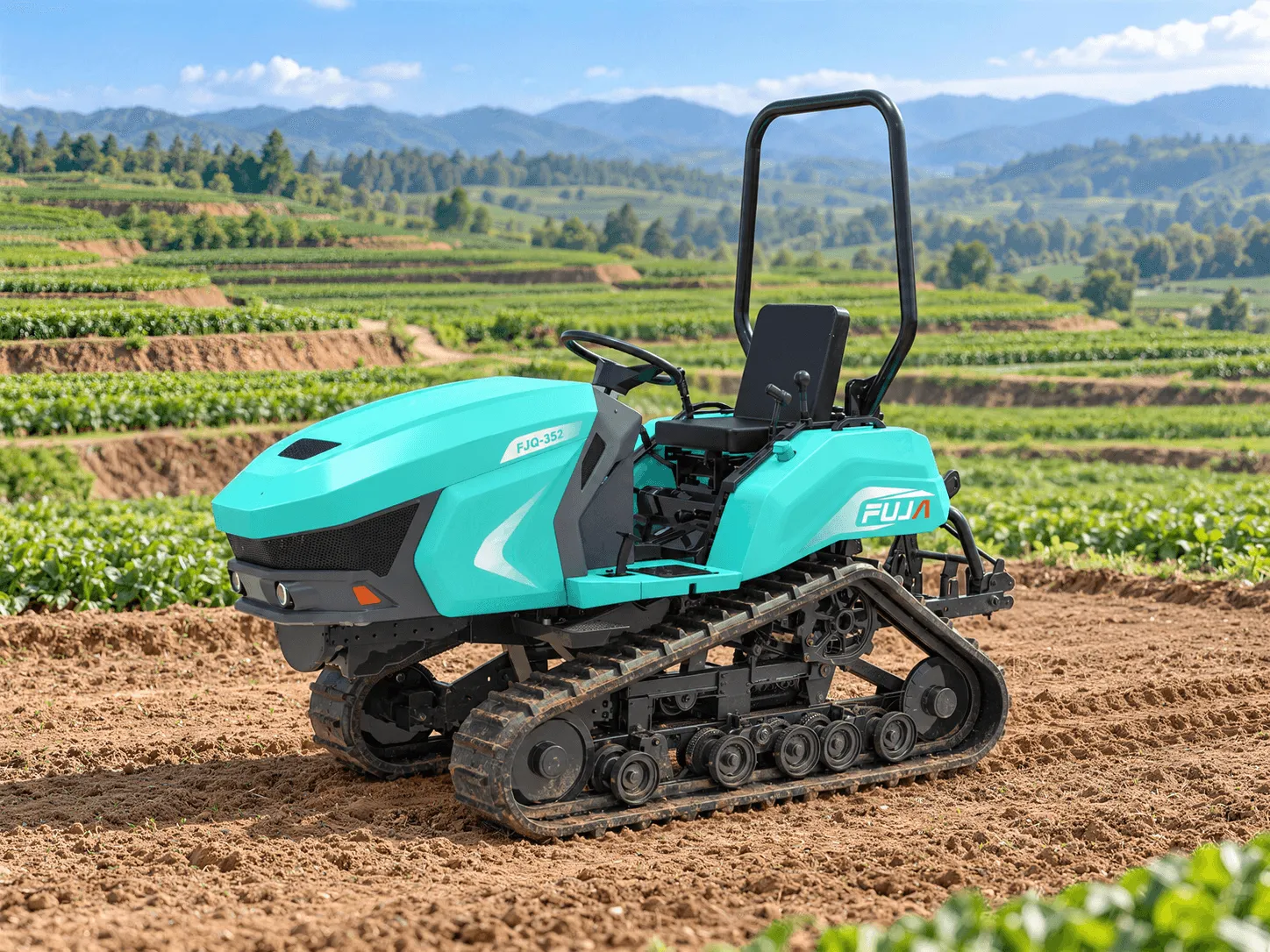
The FUJIA FJQ-352 mini crawler tractor has a listed overall width of 1,150 mm and height of 1,900 mm. Its published working-width range is 1,100–1,500 mm, which makes the implement choice as important as the tractor body when assessing a narrow row. Confirm the exact attachment dimensions and required clearance before ordering; the published dimensions alone do not establish an orchard application.
Turning, compaction and crop protection
Turning changes the comparison. A tracked machine can use differential steering to turn tightly, but a sharp turn causes tracks to scrub the surface. In an orchard, that can disturb a grass alley or loosen soil near trees. Where space permits, use a wider, gradual turn and choose a suitable headland. Wheeled tractors also need careful turns: the rear wheel and implement follow different paths, and tight steering can damage wet ground or crops.
Ground pressure is not the whole compaction story. Axle or track load, tire inflation, soil moisture and repeated traffic influence damage at different depths. Compare both machines with their expected ballast and attachments; where possible, keep traffic on planned lanes and avoid unnecessary passes when soil is too wet.
Transport and service can change the answer
If the tractor spends much of its time moving on firm roads between blocks, the travel characteristics of a wheeled model may outweigh the crawler's soft-ground benefit. If it spends most of its season in paddies where access is the limiting factor, a tracked configuration may justify a closer look. Ask each supplier for travel speed, transport restrictions, expected maintenance items, parts availability and a quotation for the intended configuration. Compare ownership costs using actual operating hours and local service rates rather than assuming one design is always cheaper.
Choose using the limiting job
- Describe the hardest task. Record field moisture, soft spots, slope, working window and the implement's load.
- Measure the narrowest route. Include row spacing, canopy height, gates, headlands and implement overhang.
- Compare complete configurations. Request operating weight with ballast and implement, track or tire dimensions, ground clearance, PTO and hydraulic compatibility, and turning requirements.
- Validate on site where possible. Check access, traction, rutting, turning and crop clearance in representative conditions. Stop if stability or ground support is uncertain; follow the manufacturer's operating limits.
- Review ownership and support. Compare transport arrangements, wear items, service access, spare parts and local support for the expected duty cycle.
For an initial review, contact FUJIA with photos of the field, row measurements, soil conditions, the intended implement and its mounting, PTO and hydraulic requirements. That information makes a model discussion more useful than a horsepower figure alone.
Frequently asked questions
Is the FJG1002 suitable for every wet field?
No single tractor is suitable for every wet field. The FJG1002 is a paddy-field crawler model, but suitability depends on the soil, mud, access route and implement. Share these conditions and ask for a configuration and field assessment.
Can the FJQ-352 fit between orchard rows?
Its listed body width is 1,150 mm, but the tractor, implement and operating clearance must all fit the narrowest section. Check canopy height and turning space as well, and confirm the exact configuration with FUJIA before purchase.
Will a crawler always compact soil less than a wheeled tractor?
No. Contact area, total load, tire inflation, soil condition and number of passes all affect the outcome. Ask for the operating weights and ground-contact details of the complete machines, then compare them under representative conditions.
What implement information should I send for a crawler tractor inquiry?
Provide the implement type, working width, mounting arrangement, required PTO speed and power, hydraulic connections and expected operating depth. FUJIA's crawler tractor range provides a starting point; confirm the interfaces for the specific tractor and attachment.