
 EN
 HR

A high-speed rice seedling sowing line can help a large nursery process trays faster, coordinate labor and repeat the same preparation steps across a production batch. The value is greatest when tray demand is concentrated in a short sowing window and the nursery can supply materials and move finished trays at the pace of the line.
For a nursery manager, the purchase decision is about more than the advertised trays per hour. The line must match the tray, seed preparation, growing medium and downstream capacity used at the site. Its real contribution should be measured in usable trays delivered on schedule, labor hours and total cost per accepted tray.
Process more trays within the sowing window
When many growers need seedlings for the same transplanting period, a nursery must coordinate tray preparation around a narrow seasonal schedule. Higher line capacity can reduce the time needed for a given batch or create room for a larger batch. The benefit depends on how consistently the whole operation can run, including setup, replenishment, changeovers, cleaning and tray movement.
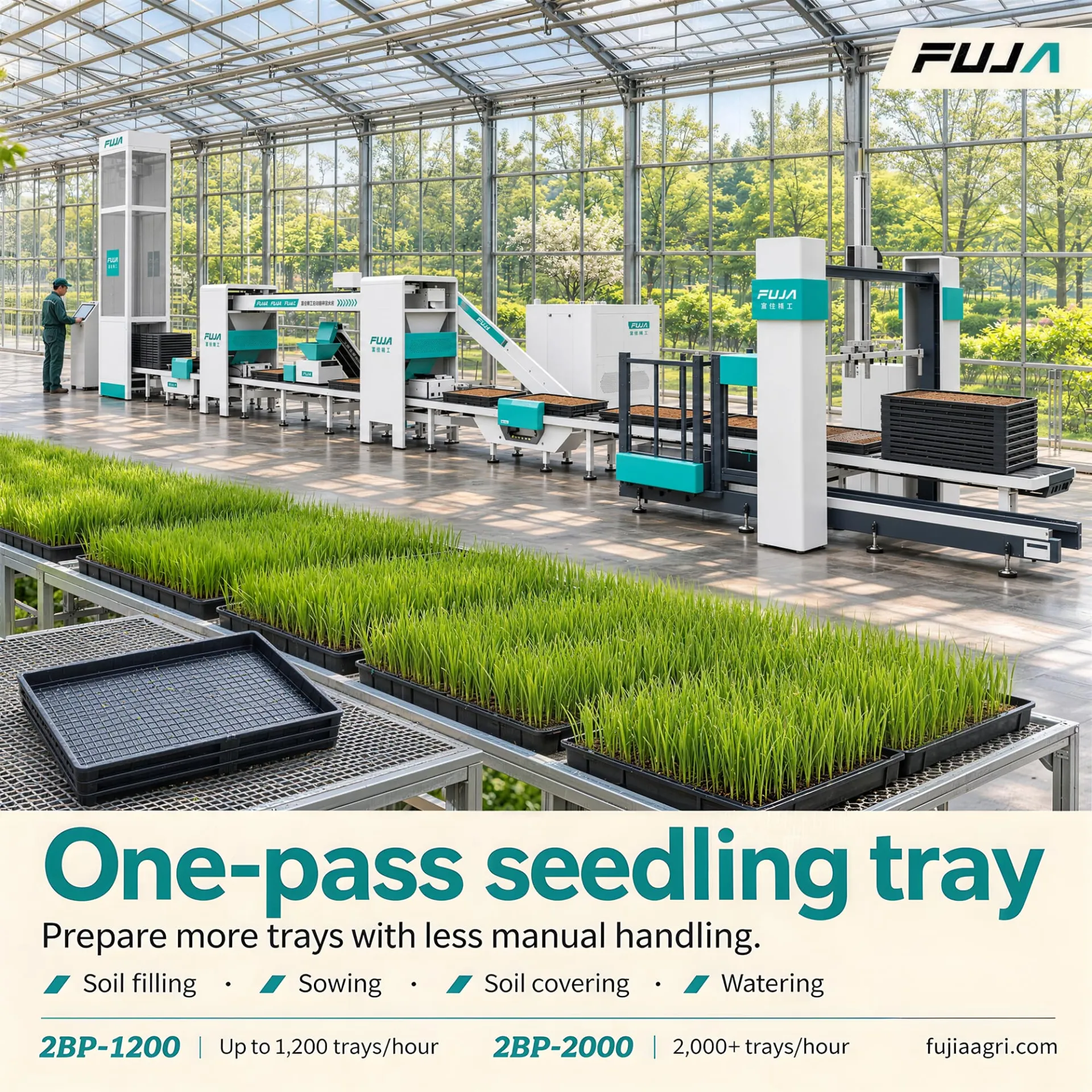
The FUJIA 2BP-2000 high-speed rice seedling sowing line is rated at at least 2,000 trays per hour. This is an equipment productivity specification, not a promise of 2,000 accepted trays every hour of a shift. To plan a batch, use a measured operating rate and include stoppages and quality checks.
For example, 12,000 trays divided by a hypothetical observed rate of 1,500 accepted trays per hour gives eight hours of production time. That rate is an illustration, not a FUJIA performance claim; the site must establish its own rate during a representative run.
Reduce repetitive handling and reorganize labor
A continuous line can replace separate manual transfers between preparation stages. The 2BP-2000 combines tray feeding and separation with soil spreading, pressing, watering, seeding, covering, a second watering pass and stacking. This arrangement allows a nursery to reassess where people are needed: preparing seed and medium, supplying trays, monitoring settings, checking output and moving stacks to the next area.
Automation does not eliminate all labor. Operators still need to replenish materials, respond to interruptions, clean the equipment and handle trays outside the line. Compare total labor hours for the same number of accepted trays, including preparation and downstream handling, rather than counting only the people standing beside the machine. The saving will depend on the nursery's existing process and staffing.
Make tray preparation easier to control
At scale, variation between shifts or batches makes it harder to plan nursery space and meet a customer's tray specification. A mechanized sequence provides repeatable settings for soil application and seed metering, but repeatability still depends on calibrated equipment and consistent inputs.
The 2BP-2000 uses stepless seeding-rate adjustment and a rotary brush for leveling. Before a production run, agree on the target seed quantity per tray and cover depth, then sample trays across the width of the line. Recheck after changing rice variety, seed condition, tray type or growing medium. Record the settings that produced an acceptable result so the next shift has a practical starting point.
More consistent sowing preparation can support a more manageable batch, but it does not by itself guarantee germination, uniform seedlings or higher field yield. Seed quality, water, temperature, disease management and subsequent nursery care also matter.
Make material use and rework visible
Overfilling trays, applying too much seed or rejecting poorly prepared trays all add cost across a large batch. A controlled setting and routine sampling give managers a way to identify variation early and adjust the process before it affects the whole run.
Weigh seed used against the number of accepted trays, check soil depth and covering at agreed intervals, and record rejects by cause. Compare the same rice variety and tray format before and after a change. These records can show whether the line is reducing waste at your site; do not assume a particular percentage saving without a measured baseline.
Connect sowing output to nursery operations
A faster sowing line can expose bottlenecks elsewhere. If empty trays arrive too slowly, the line waits. If completed trays cannot be moved to the germination or growing area quickly enough, stacks accumulate at the outlet. A lack of medium, water or staff for handling can have the same effect.
| Operation | What to check before sizing the line | Why it affects the result |
|---|---|---|
| Incoming trays | Tray dimensions, rigidity, nesting and condition; confirm separation and stacking compatibility. | Incompatible or damaged trays can interrupt feeding or require manual intervention. |
| Seed and medium | Rice variety and seed preparation; medium particle size, moisture and supply method. | Input variation can change flow and the required settings. |
| Utilities and layout | Available floor area, material access, water supply, drainage and electrical supply. | The line must fit safely and be supplied continuously. |
| Downstream handling | Staff, carts and space to move and place finished trays. | A blocked outlet can prevent the line from operating at its intended pace. |
| Quality checks | Sampling frequency, target seed rate, cover depth and acceptance criteria. | Output is useful only when trays meet the nursery's specification. |
The 2BP-2000 is a stationary electric machine with listed operating dimensions of 22.8 × 1.55 × 2.5 m and total power output of 9.50 kW. Reserve additional room for material access, maintenance and tray movement, and confirm the electrical connection and site layout with FUJIA.
Assess the return using accepted trays
Start with the nursery's peak-season tray requirement and current records. Then compare a proposed line against the existing process over the same production volume and period. Include purchase and installation, training, electricity, maintenance, consumables, labor, material use and the cost of handling trays before and after sowing.
- Set the baseline: record accepted trays per shift, total labor hours, rejects and material consumption for the current process.
- Calculate capacity required: divide the planned accepted-tray volume by the available production hours, then allow for setup, interruptions and batch changes.
- Check the bottleneck: compare line capacity with tray supply and the rate at which completed trays can be moved and placed.
- Run a representative trial: use the actual tray, seed and medium; measure accepted output, staffing and stoppages over a meaningful run.
- Compare annual costs and benefits: use local wages, operating costs and realistic seasonal utilization. Consider whether extra capacity is needed outside the peak period.
A nursery with a short, intense production window may value schedule capacity even if the line is idle for part of the year. A smaller operation with lower peak demand may find a more compact line sufficient. FUJIA also offers the 2BP-1200 rice seeding line; compare the actual configuration, throughput and footprint rather than selecting by model number alone.
To assess a high-speed line for your nursery, send FUJIA your peak tray demand, available working hours, tray dimensions, rice varieties, seed and medium conditions, site layout and downstream handling method. Ask for a configuration review and a trial plan using your materials.
Frequently asked questions
How many trays can the FUJIA 2BP-2000 process in a working day?
Its listed hourly productivity is at least 2,000 trays, but daily accepted output depends on operating hours, setup, stoppages, materials and quality checks. Use a representative site trial to establish a planning rate.
Can the line handle our existing rice seedling trays?
Compatibility should be confirmed before purchase. Send FUJIA the tray dimensions, material, nesting arrangement and samples if requested. Ask for feeding, separation and stacking to be checked with the actual tray.
Does a high-speed line reduce the number of workers required?
It can reduce repetitive handling within the sowing sequence, but the staffing outcome depends on material supply, monitoring, tray movement and the current process. Compare total labor hours per accepted tray, including work outside the machine.
Can the seeding rate be changed for different rice varieties?
The 2BP-2000 has stepless seeding-rate adjustment. Provide the variety, seed condition, tray format and target quantity per tray, then confirm calibration and sample the output when changing batches.